If you searched for transaction management software, you're probably comparing tools and trying to figure out which one fits your situation. This is a guide for that — what the category actually covers, who buys it, and how the leading platforms differ.
Transaction management software is the layer of tools that takes over once a real estate deal is under contract: documents, e-signatures, checklists, deadlines, compliance, audit trails, and the communication that holds it together until closing.
Here's the catch most buyer's guides skip: most software in this category was built for brokerages managing many transactions across many agents. If you're the person actually closing deals — a coordinator, a self-coordinating agent, a solo broker — you probably need something different. This page covers both worlds, names the leading tools honestly, and helps you pick the one that fits the work you actually do.
What is real estate transaction management software?
Transaction management software is the digital file room and operations layer for a real estate deal. The core capabilities are consistent across every serious platform: a place to store the contract and every related document, e-signature (built-in or integrated), checklists keyed to the contract type and state, deadline tracking, compliance review, an audit trail that survives a state board audit, and shared access for the agents, clients, lenders, and attorneys involved.
The category overlaps heavily with transaction coordination software. The features look similar at a glance. The difference is who the software is sold to. “Transaction management” tools are usually pitched at brokerages and team leaders. “Transaction coordination” tools are pitched at the person inside the transaction. Same software underneath, different design assumptions.
Who actually uses transaction management software?
Brokerages and team leaders
Manage dozens to thousands of transactions across many agents. The buying criteria are oversight, compliance, and audit readiness — who is closing what, are deadlines being hit, can you pull a clean audit if the state asks.
Transaction coordinators
Close transactions for a living. Document chase, deadline calendar, agent and client updates, compliance checks. Buying criteria are speed and accuracy — open a file fast, build the timeline fast, miss nothing.
Self-coordinating agents & solo brokers
Doing two or three jobs: prospecting, closing, and (for brokers) compliance. You don't need brokerage oversight tooling because you are the brokerage. You need the coordinator's toolset with minimum admin overhead.
Solo broker? See our broker-specific guide.
What coordination-first looks like in practice
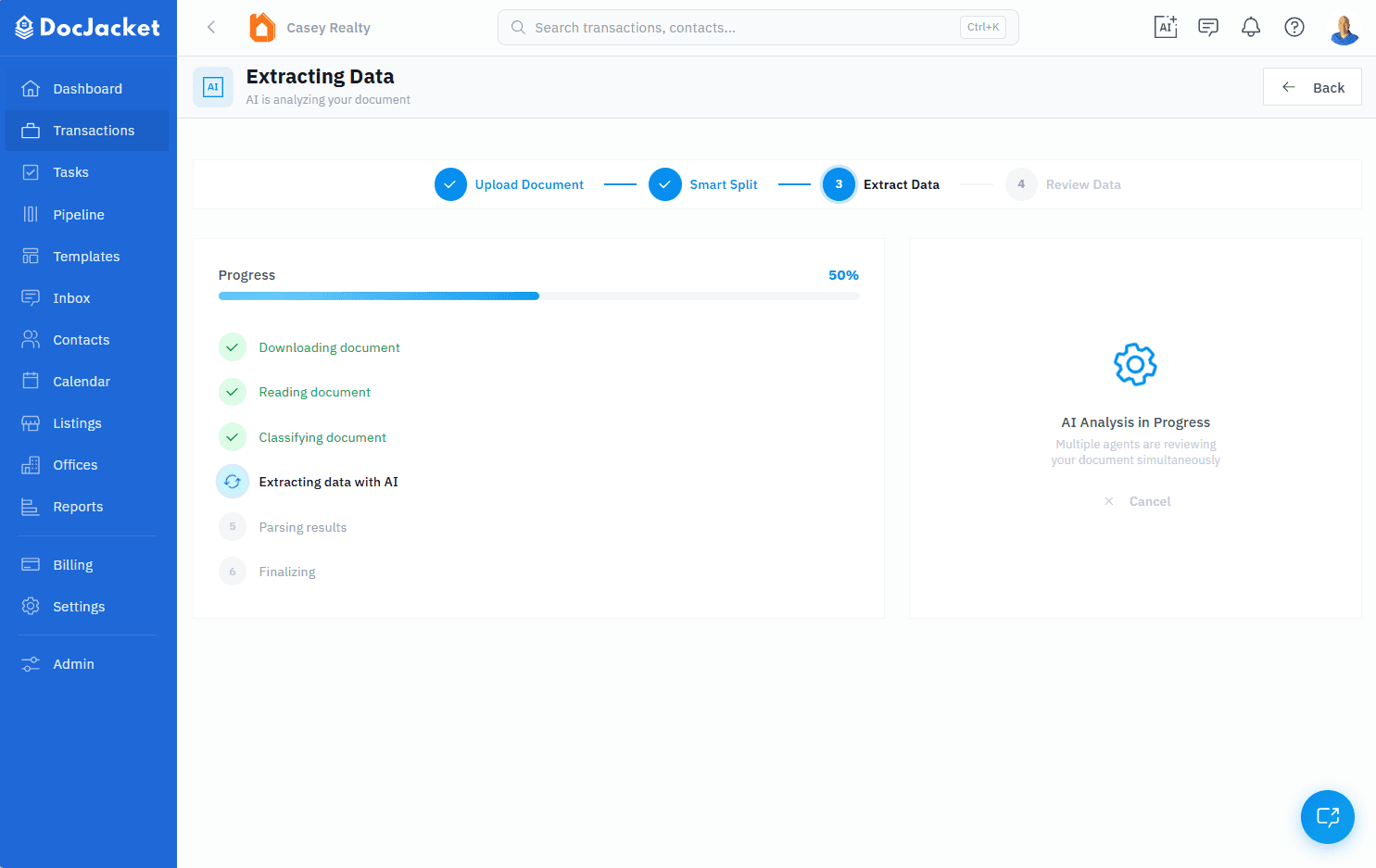
Most transaction management tools open with a brokerage-wide pipeline view. Coordination-first tools open with the file itself — the contract uploaded, parties and dates extracted, the timeline already drafted. That difference shapes every comparison below.
- AI reads the contract and pre-fills the file in minutes, not hours
- Timeline auto-builds from contract terms and adjusts when dates move
- Agent and client portals are free — only coordinators consume a seat
The leading real estate transaction management platforms

DocJacket
Built for the person who actually closes the deal. The AI reads contracts and pre-fills the file — parties, dates, contingencies, sale price — so opening a new transaction takes minutes, not hours. The pricing model is flat per-coordinator-seat with unlimited transactions and unlimited agent and client invitations, which is unusual in this category.
The bet behind DocJacket is that the work bottleneck for most independent TCs and self-coordinating agents is the prep — extracting contract data, building the timeline, chasing the missing initials — not the oversight. So that's where the product is sharpest. It's deliberately not pitched at large brokerages: if you need a top-down compliance dashboard across 200 agents, look at SkySlope or Paperless Pipeline instead.
- Best for:
- Coordinators and self-coordinating agents who want AI to do the prep work
- Pricing starts at:
- $15–$29/seat/mo, no per-transaction fees
- Key strength:
- AI contract extraction, fast file open, coordination-first design
- Key weakness:
- Less dashboard tooling for brokerages overseeing many agents

Dotloop
The legacy market leader for individual agents. Dotloop's e-signature heritage is its real moat — most people in real estate have signed something inside it. The TM features are competent and broadly integrated, and the brokerage tier is widely deployed. The trade-off is age: the workflow assumes a lot of manual document handling relative to newer AI-first tools.
- Best for:
- Agents and brokerages that want e-signature and TM in one suite
- Pricing starts at:
- $31.99/mo for individual agents ($21.16/mo billed annually); brokerage pricing custom
- Key strength:
- Mature e-signature, broad real estate adoption, MLS integrations
- Key weakness:
- Per-transaction overhead at volume; UI shows its age in places

Open to Close
Open to Close has a foot in both camps. It was built around the coordinator's workflow, and the feature set has grown over the years to include brokerage and team oversight. The result is a product that does both — well — but is heavier to set up than tools that pick a side.
Solid choice if you're a TC team that's scaling, or a brokerage that wants something more coordinator-aware than a pure compliance tool. The pricing climbs once you start adding team features, so the math gets harder if you're a one- or two-person operation.
- Best for:
- Established TC teams and small-to-midsize brokerages
- Pricing starts at:
- Plans run $99–$399/mo
- Key strength:
- Strong coordinator workflow with brokerage-grade reporting
- Key weakness:
- Heavier setup; pricing climbs with team features

ListedKit
The clearest direct competitor to DocJacket on the AI angle. ListedKit's pitch is an AI assistant that handles routine coordinator work — drafting status emails, chasing documents, surfacing deadlines. The product is well-designed and the team is shipping fast. The catch with newer tools is always integrations and edge cases; the depth comes with time.
- Best for:
- TCs and small teams who want an AI-positioned alternative to legacy tools
- Pricing starts at:
- $9.99 per contract intake (no monthly fee; first intake free; volume credit discounts available)
- Key strength:
- AI assistant (“Ava”) for routine TC tasks, modern UX
- Key weakness:
- Newer entrant — fewer integrations and a smaller user base than incumbents

Paperless Pipeline
A long-running favorite for small brokerages. Paperless Pipeline does the boring, critical things well: file storage, checklists, audit logs, and a clean broker review workflow. The interface is unfussy — it doesn't try to dazzle you with AI, and it doesn't need to.
What it's not trying to be is a coordinator productivity tool. The workflow assumes an admin or TC is on the other end of every file, doing the actual prep work elsewhere. If your problem is “keep the brokerage clean for an audit,” it's a reasonable answer. If your problem is “help my coordinator open files faster,” it's the wrong tool.
- Best for:
- Small-to-midsize brokerages focused on compliance and back-office
- Pricing starts at:
- Per-transaction tiers from $65/mo (5 deals) up to $675/mo (450 deals); unlimited users included
- Key strength:
- Simple, reliable broker compliance and audit trail
- Key weakness:
- Per-transaction fees add up at volume; less coordinator-facing AI

SkySlope
SkySlope is what large brokerages and franchises buy when compliance is the central concern. The platform is built around broker review, audit, and risk management at scale, with the support apparatus to match. If you're running a 500-agent franchise, it's a credible default. If you're a TC or solo broker, you'll never use most of what you're paying for.
- Best for:
- Enterprise brokerages and franchises with heavy compliance needs
- Pricing starts at:
- Suite from $340/mo brokerage-wide; larger accounts custom
- Key strength:
- Deep compliance tooling, broker auditing, large-account support
- Key weakness:
- Enterprise pricing and complexity; overkill for small operators
Transaction Management vs. Transaction Coordination Software
Both terms describe overlapping software, but the buyer is different — and that difference shows up in every design decision the product makes.
Transaction management is built for brokerages tracking many transactions across many agents. The home screen is a pipeline view. The reports are about agent performance and compliance status. The permissions model assumes a broker reviewing what agents are submitting. The pricing model usually scales by transaction or agent, because the buyer is signing a multi-seat contract.
Transaction coordination is built for the person actually closing the deal. The home screen is the active file. The features are about speed: how fast can you open a transaction, build the timeline, request a missing document, draft a status email. The pricing model is per-seat with unlimited transactions, because the buyer is a coordinator who'd rather pay a flat number than count files.
If you're the one doing the work, coordination software is a better fit. If you're managing a team that does the work, transaction management software might fit better. Many people end up needing both, in which case the question is which one is the daily driver.
A concrete example: imagine a contract just came in. On a TM-first tool, the next screen is the brokerage pipeline — a list of every active deal, color-coded by status. You navigate into the new file. On a coordination-first tool, the next screen is the new file itself, with the AI already extracting parties and dates while you're still setting it up. Same software category, different first move. Which one matches how you spend your day?

DocJacket is built for coordinators and self-coordinating agents — the people who actually close the transaction.
Per-coordinator-seat. Unlimited everything else.
Most TM tools charge by transaction or by agent — both numbers that grow with your business and shrink your margin. DocJacket charges per coordinator seat and leaves the rest unmetered.
$15 per coordinator per month while founding seats are open, $29 after. No per-transaction fees, no per-agent fees, no annual contract.
- Unlimited transactions
- Unlimited agents on the free Agent Portal
- Unlimited buyers and sellers on the free Client Portal
- Unlimited e-signatures and document storage
How to choose the right tool for your role
I'm a TC or self-coordinating agent
Look at coordination-first tools. Buy on speed, AI accuracy, and how few clicks it takes to do the daily work — DocJacket, Open to Close, ListedKit are the shortlist.
I'm a broker with a team of agents
Look at the team-tier of TM platforms — Open to Close, Dotloop, Paperless Pipeline. Buy on oversight, agent compliance, and broker audit readiness.
I run a brokerage with multiple offices
Enterprise compliance is the dominant concern. SkySlope and the brokerage tier of Paperless Pipeline are the usual answers. Expect a sales conversation and a real implementation project.
I'm a TC or self-coordinating agent
Look at coordination-first tools. Buy on speed, AI accuracy, and how few clicks it takes to do the daily work — DocJacket, Open to Close, ListedKit are the shortlist.
I'm a broker with a team of agents
Look at the team-tier of TM platforms — Open to Close, Dotloop, Paperless Pipeline. Buy on oversight, agent compliance, and broker audit readiness.
I run a brokerage with multiple offices
Enterprise compliance is the dominant concern. SkySlope and the brokerage tier of Paperless Pipeline are the usual answers. Expect a sales conversation and a real implementation project.
Key features to evaluate

Document storage & audit trail
Every contract, addendum, and disclosure stored with a complete, exportable audit log.

E-signature
Built in, or a clean integration with the one you already use.

Checklists & templates
Keyed to contract type and state, with deadlines that auto-calculate from the contract.

AI document extraction
How accurate it actually is on the contracts you handle — not a polished demo.

Compliance & archiving
WORM-compliant retention for state board audits, with the right access controls.

Agent & client collaboration
Lightweight portals that don't require every party to create a login.

Status communication
Automated client emails, branded portals, and lender updates that fire on milestones.

Pricing model
Per-seat, per-transaction, or per-agent — and what your bill looks like at volume.
Frequently asked questions
Common questions
Transaction management software is the layer of tools that runs a real estate deal from contract to close — documents, e-signatures, checklists, deadlines, compliance, audit trails, and the communication that holds it together until closing. Most TM platforms are sold to brokerages tracking many transactions across many agents. Coordination-first variants (sometimes called transaction coordination software) are sold to the person actually closing the deal. Same software category, different design assumptions about who's using it.
There isn't one. The right pick depends on whether you're a brokerage tracking many agents, a coordinator closing files, or a solo broker doing both. For coordinators and self-coordinating agents: DocJacket, Open to Close, ListedKit. For brokerage compliance: Paperless Pipeline, SkySlope, brokerage-tier Dotloop. For individual agents wanting an integrated e-signature suite: Dotloop. The comparison cards above lay out pricing, strengths, and weaknesses so you can match a tool to how you actually spend your day.
The software overlaps heavily — both handle documents, deadlines, checklists, and compliance. The difference is who the buyer is. Transaction management software is sold to brokerages who need to track many transactions across many agents. Transaction coordination software is sold to the person who actually closes the deal — a coordinator, a self-coordinating agent, a solo broker. If you spend your day inside transactions, coordination software fits better. If you spend your day overseeing agents who are inside transactions, TM software fits better.
Solo agents who handle their own files usually don't need full TM software — they need coordination software, because the work they do is coordinator work. A team-oriented TM platform with agent oversight, performance dashboards, and brokerage compliance reports is overkill for one person closing their own deals. Look at transaction coordination software instead.
Pricing models vary more than you'd expect. Paperless Pipeline charges per-transaction tiers ($65/mo for 5 deals up to $675/mo for 450). ListedKit charges per contract intake ($9.99/credit, first one free). Dotloop is $31.99/mo for individual agents with custom brokerage pricing. Open to Close runs $99–$399/mo. SkySlope's Suite starts at $340/mo brokerage-wide. DocJacket pricing is $15–$29 per coordinator seat per month with unlimited transactions, agents, and clients. The math worth running: transactions per month, seats needed, and what happens to your bill at volume.
No. A CRM tracks people and pipeline — leads, contacts, deal stage, marketing touches. Transaction management software takes over once a deal is under contract: documents, deadlines, signatures, compliance, closing. Most teams run both. A few platforms try to do both and end up doing neither well.
Software can replace some of what a TC does — checklists, reminders, document handling, status emails. It can't replace judgement: knowing when an addendum is needed, catching the missing disclosure that nobody else noticed, calling the lender at 7pm to unstick a closing. The right software makes a coordinator faster. It doesn't make a coordinator unnecessary.
For brokerages under ~25 agents, Paperless Pipeline and Open to Close are the most common picks — both are reasonably priced and have agent oversight built in. If your brokerage is small enough that the broker is also coordinating deals, look at coordination-first tools. See our comparison of the best transaction coordinator software for a breakdown.